What I write about comes from reading seriously across business, economics, philosophy, systems theory, and technology. Not to collect frameworks, but to build with them. I read a framework, stress-test it against what I have actually seen work and fail, and then build my own version adapted to the situation in front of me. That approach is backed by a formal foundation: a BA in Business and Economics, an MBA, and my current work as an MISM candidate, but it was twenty years in operations and a stint as a Navy Hospital Corpsman that taught me how to break those models down to what actually works.
The living wiki I run in Obsidian and the Council of Rivals multi-agent architecture I am building are not just things I read about and replicated. They are custom-designed systems built from first principles after years of reading, experimenting, and breaking things. I write about that process here: what I build, what breaks, and what I learn along the way. The four pillars below are the output of that way of thinking, not a content calendar. Want to know more about who is behind this? Start with the About page.
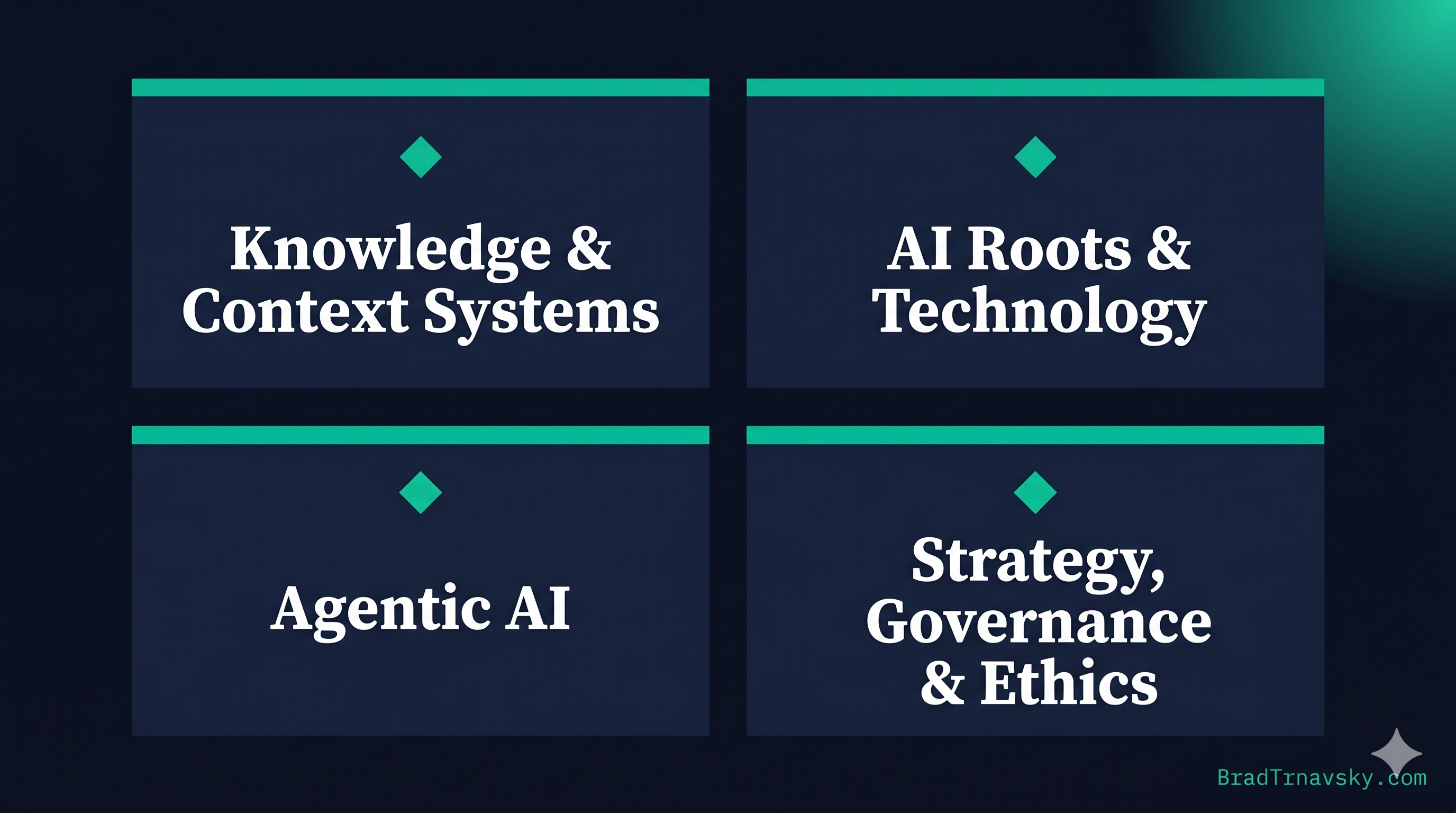
Knowledge & Context Systems
Your knowledge architecture is either compounding or decaying. Most people never think about this. They save files, bookmark links, and take notes without any system for retrieval or connection. Then they wonder why AI tools give them generic answers.
The quality of AI output is bounded by the quality of the context you provide. I built a deep personal knowledge and AI context system in Obsidian, a living wiki, daily notes, project hubs, and build specs, unified by a hybrid RAG pipeline with multi-search and reranking designed to make me smarter over time by helping me spot cross-domain connections that are not obvious and give my AI tools the context they need to produce real high-quality personal output.
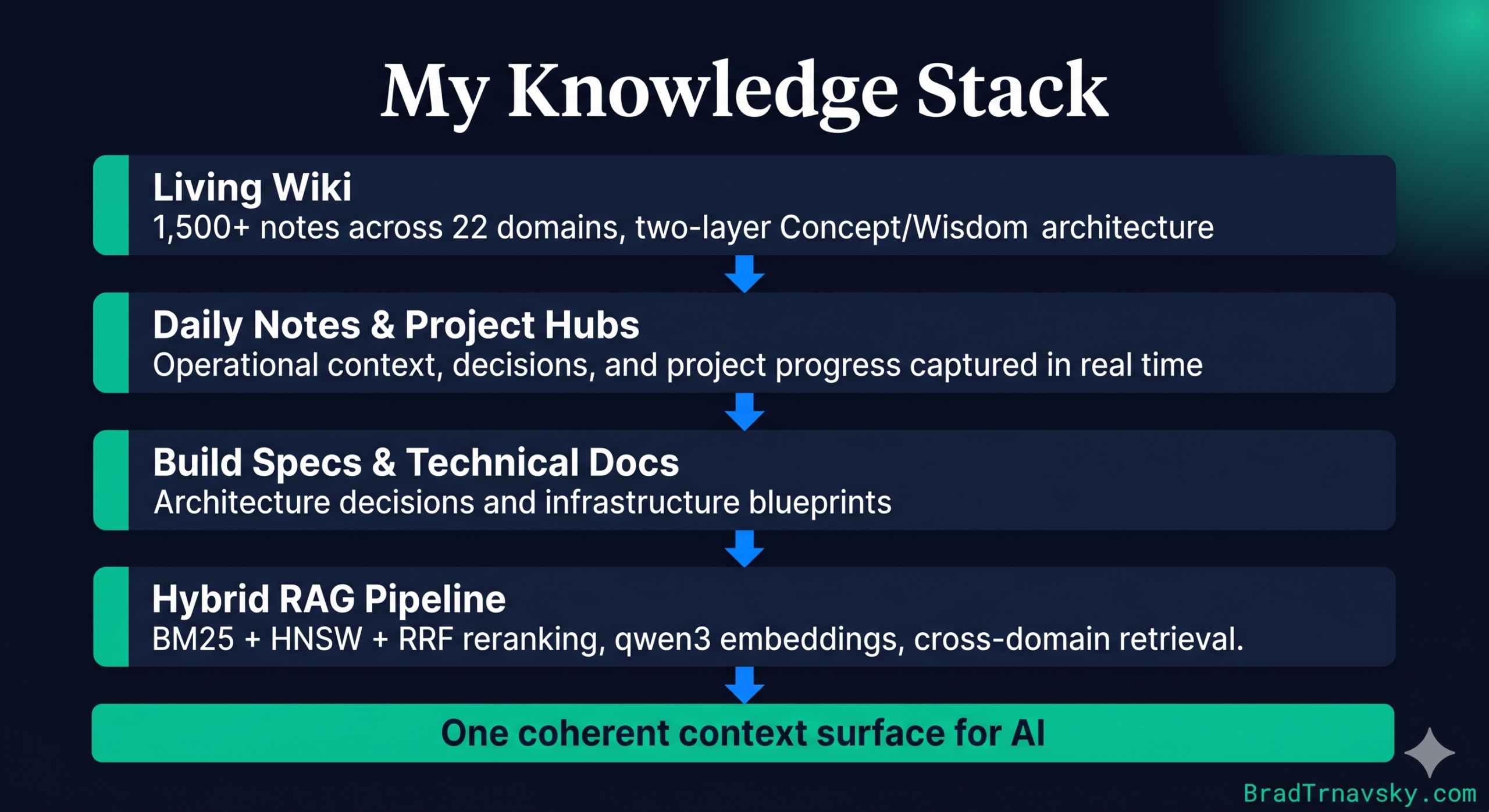
I write about Personal Knowledge Management (PKM), Retrieval Augmented Generation (RAG) architecture, and Personal Context Management (PCM) because in the age of AI, what you know and how you structure it is the difference between compounding and stagnating. If you are trying to make AI useful without first building the knowledge layer underneath, this thread will save you years of wasted effort.
→ Browse all posts in Knowledge & Context Systems
AI Roots & Technology
You cannot make good decisions about AI if you do not understand what it actually is. Most people using large language models daily have no mental model of what is happening under the hood. They treat it like magic, a search engine, or a threat. None of those framings produce good decisions.
I write about the conceptual and historical foundations: What is AI, and how does it work? What do machine learning and deep learning actually do? How transformers work at a first-principles level, why scale matters, and where the real limitations are. The point is not to train engineers. It is to give decision-makers the technical literacy to evaluate AI claims, ask the right questions, think in systems, be solution-focused rather than product-focused, and avoid expensive mistakes. If you want to understand the machine rather than just react to it, start here.
→ Browse all posts in AI Roots & Technology
Agentic AI
There is a wide gap between AI demos and AI that works reliably at scale. I write from the side of having built and run the system. My stack includes Hermes Agent, n8n, and pgvector RAG. Obsidian and WordPress MCP.
My agent swarm, The Council of Rivals, the multi-agent architecture I am currently building, uses specialist agents with distinct perspectives to critique and pressure-test each other’s outputs. I write about what it actually takes to deploy agents in workflows that matter: context management, error handling, cost control, and the organizational discipline required to keep the system running. Every post in this thread is grounded in something I have built, broken, and fixed. If you are past the demo phase and trying to make AI work in production, personal, or organizational settings, this is the thread for you.
→ Browse all posts in Agentic AI
Strategy, Governance & Ethics
Most AI adoption failures do not stem from the technology but from organizational and leadership decisions around it. I have spent twenty years in operations and leadership across military, education, and logistics environments. The pattern is consistent: organizations buy the tool, skip the foundation, and then wonder why adoption stalls and skepticism compounds.
Governance is not the guardrail you bolt on after the fact. It is the load-bearing structure that determines whether anything else holds up under use. I write about building that foundation: the governance frameworks that make AI initiatives stick, the change management discipline that is non-negotiable, and the leadership required to guide a team through technological transformation without losing the people in the process.
Stuart Russell’s work on beneficial AI, Kotter’s research on why change efforts fail, and the Toyota principle of using only thoroughly tested technology that serves your people all live in this thread. If you are responsible for AI adoption in an organization of any size, this is where the tool vendors’ documentation will not take you.
→ Browse all posts in Strategy, Governance & Ethics
What I Write About: The Connective Tissue
These four pillars are not separate interests. They are a single coherent practice: understand the technology, build the knowledge systems to work with it, deploy it in real workflows, and lead the organizational change required to make it stick. I write about all four because none of them work without the others.
Ready to Go Deeper?
Start with the blog and see what is already in the archive. If you are working on something at the intersection of AI strategy and operational execution and want to compare notes, reach out.