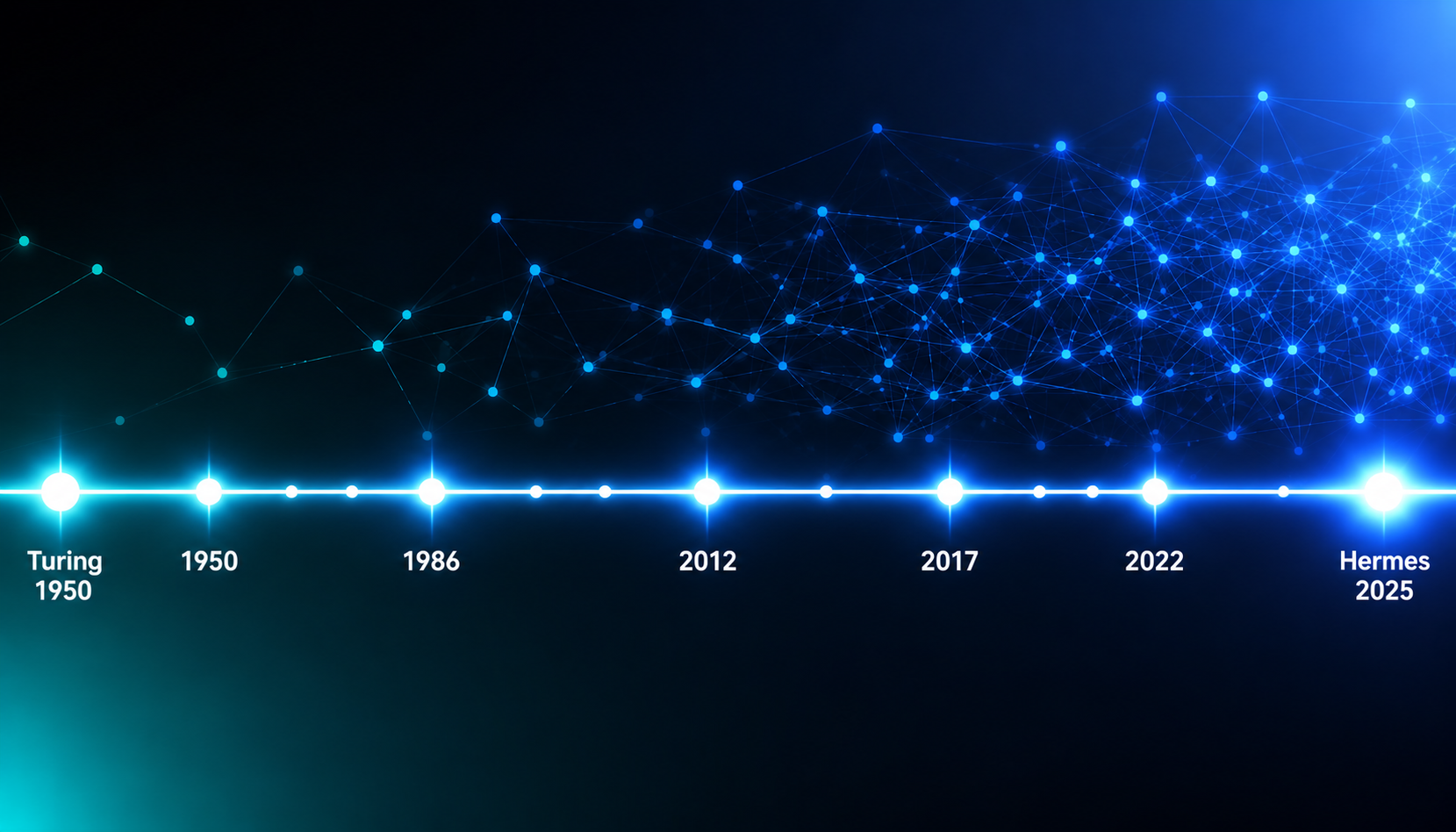

- 75 years of AI history is a cynical cycle of hype, scaling failure, and defunded winters — not steady progress.
- The real breakthroughs came from rogue physicists and psychologists, not the institutional gatekeepers who repeatedly stifled them.
- Symbolic AI failed because brittle rules can’t capture the real world. Neural networks won because data and compute finally caught up to the theory.
- The agent turn changes everything: LLMs with memory, tools, and decision loops are a fundamentally different category of system.
- The alignment problem is not theoretical. It is the engineering challenge of our generation.
- I run an 11-profile adversarial swarm in WSL2 from a desk in East Texas. That is the practical endpoint of this history.
Table of Contents
The Real History of Artificial Intelligence
The modern enterprise is obsessed with the wrong AI metrics. Boardrooms argue over model size, context windows, and token velocity while ignoring the underlying architectural structure. We treat these systems like alien magic rather than what they actually are: the ultimate victory in a 75-year ideological war.
Since the 1950s, academic gatekeepers have insisted that top-down logical rules can capture intelligence. They were wrong. The real history of artificial intelligence is a brutal transition from brittle, human-coded systems to bottom-up, data-driven neural networks that run our world today. To understand why an autonomous multi-agent swarm works on a modern desktop, you have to understand the foundational flaw that broke the old paradigm from day one. We have to go back to the dare.
Alan Turing and the Imitation Game
In 1950, Alan Turing published a paper in the journal Mind with a title that sounded like a dare: “Computing Machinery and Intelligence.” He opened not with an answer but with a question. Can machines think? He immediately flagged the problem. The words “machine” and “think” were both slippery; you could spend years arguing definitions and get nowhere. So Turing did something more useful. He replaced the question with a test — what we now call the Alan Turing Imitation Game.
The Imitation Game was simple: an interrogator in one room, two subjects in another. One human, one machine. The interrogator asks questions. Based on the answers alone, can the interrogator tell which is which? If a machine could fool a human judge as often as a human could, Turing argued, then the question of “thinking” became irrelevant. What mattered was behavior you could measure.
This was radical for 1950. It sidestepped philosophy and gave engineers something to build toward. It also planted a seed that would take 75 years to fully germinate: the idea that intelligence might not be about what you are, but about what you can do.
Turing also saw the trap. He explicitly rejected defining “thinking” by examining common usage. A statistical survey of what people mean by “intelligent” would not answer the question. He replaced the philosopher’s question with the engineer’s question: Can a machine act indistinguishably from a thinking being? It was the right move. But it set a structural trap. The industry permanently blurred the line between simulated performance and actual understanding. That exact issue persists today. We ask an LLM a question, and it answers. It feels like understanding, but it isn’t. The model doesn’t actually know anything. It mimics, cannot create original thought, and just regurgitates the training data.
Six years later, John McCarthy, Marvin Minsky, Nathaniel Rochester, and Claude Shannon gathered at Dartmouth for what became the founding conference of the field of artificial intelligence. The term “artificial intelligence” was McCarthy’s choice; he wanted to nail the flag to the mast and distinguish the work from automata studies that had come before. McCarthy was reportedly disappointed by how few prior papers addressed the problem of making machines behave intelligently. The field had a name, an agenda, and a level of confidence that the underlying problems could be solved in a single summer. That confidence would prove premature.
The AI Winters: Expert Systems and Failed Deployments
The first two decades of AI research were dominated by symbolic reasoning. If you could encode human knowledge as logical rules, a computer could reason through any problem. Expert systems emerged in the 1970s and 1980s, capturing real knowledge from real specialists and encoding it in if-then rule sets. They worked in narrow domains. They were also brittle as glass.
But before the era of expert systems, the gatekeepers had already claimed their first victim. In 1958, Frank Rosenblatt, a psychologist at Cornell, not a card-carrying member of the symbolic AI establishment, built the Perceptron, the first trainable neural network. It could learn to classify simple patterns from examples. No rules. No human-coded logic. Just data, weights, and a learning procedure. Rosenblatt told the press it was the embryo of an electronic computer that would be able to walk, talk, see, write, reproduce itself, and be conscious of its existence. That kind of talk made the symbolic AI establishment nervous.
Marvin Minsky and Seymour Papert published their response in 1969. Perceptrons was a rigorous mathematical analysis showing that single-layer perceptrons could not solve problems that were not linearly separable, like XOR, where a straight line cannot separate the output classes. The math was correct. The implication that all neural networks were therefore dead ends was not. Minsky and Papert knew about multilayer networks and chose not to analyze them. The book did not kill neural networks with its content. It killed them by its authorship and timing. Minsky was the dominant figure in the field. Funding agencies took the hint. DARPA stopped supporting connectionist research almost overnight.
That was the first act of institutional gatekeeping. It would not be the last.
The brittleness problem caught up with symbolic AI just as it had with neural networks. A system that could diagnose a specific blood disorder could not tell you it had never seen a symptom before. It had no common sense and could not generalize. The real world was messier than any rule set could capture, and scaling the rules meant exponentially more rules to maintain. This was the combinatorial explosion that the Lighthill report identified in 1973. It gutted AI research funding across the UK.
The first AI winter, roughly 1974 to 1980, was a funding collapse. DARPA cut support for undirected research after the Speech Understanding Research program at Carnegie Mellon failed to deliver practical military applications. The UK dismantled its AI labs after the Lighthill report. The pattern repeated in the late 1980s and early 1990s when the expert systems bubble burst, Japan’s Fifth Generation project failed, and DARPA’s Strategic Computing Initiative got redirected. The term “artificial intelligence” became toxic in grant proposals.
The pattern across both winters was the same. The demo worked, but the deployment did not scale. The funding dried up, and once again the cycle reset. ELIZA in 1966, R1/XCON in 1985, GitHub Copilot in 2023. Each time, the industry declared the problem solved. Each time, the hard parts remained exactly where they were.
But a small group kept working on neural networks through the dark years. John Hopfield published his paper on associative memory networks in 1982 in the Proceedings of the National Academy of Sciences, giving neural network research credibility it had been denied. Hopfield was a physicist. His framing of neural networks as spin glasses attracted physics PhDs to the field, and his paper brought Geoffrey Hinton back to neural networks after years spent working on symbolic AI. Hinton and Terry Sejnowski developed the Boltzmann machine in 1985, applying statistical mechanics to learning in hidden-layer networks. Yann LeCun at Bell Labs developed convolutional neural networks through the 1980s. David Rumelhart, Ronald Williams, and Geoffrey Hinton published the backpropagation paper in Nature in 1986.
Backpropagation was the bridge. It gave neural networks with multiple hidden layers a practical way to learn, propagating the error signal backward through the network to adjust every weight, layer by layer. The symbolic establishment mostly ignored it. The neural network researchers understood exactly what it meant: the theoretical objections from Perceptrons were no longer valid. Multilayer networks could learn the nonlinear functions that single-layer networks could not. The gatekeepers had been wrong, and the math now proved it.
The triumph of backpropagation was short-lived. Throughout the 1990s, researchers hit a mathematical wall when they tried to stack more than a few hidden layers. As the error signal propagated backward through a deep network, it shrank exponentially at each layer until it completely vanished. The weights at the front of the network stopped changing. The math was sound, but the architectures were effectively blind. Deep learning was stuck in limbo for a generation.
These researchers came from physics, psychology, and electrical engineering, not from the AI labs that controlled funding. They survived because their home departments valued the work for other reasons. The neural network revival was built on foundations laid by perhaps two hundred researchers worldwide who kept working when the mainstream told them they were wrong.
The Data Moment: Deep Learning, GPUs, and the AlexNet Breakthrough
Neural networks needed two things that were not available in sufficient quantities until the mid-2000s: large datasets and GPU-level compute. The deep learning history of this period is really a story of patience — the theory from the 1980s, backpropagation and multilayer architectures, was sound. Training a useful network required millions of examples and weeks of processing power that researchers simply did not have.
In 2006, Hinton and his collaborators published “A Fast Learning Algorithm for Deep Belief Nets.” The key insight was layer-by-layer pre-training using restricted Boltzmann machines. Instead of training a deep network all at once, Hinton’s approach trained one layer at a time and then fine-tuned the result. It was not elegant. It worked. Deep networks were not dead; they just needed the right initialization strategy.
Before the detonation, there was a cultural signal that most people misread. In 1997, IBM’s Deep Blue defeated Garry Kasparov, the reigning world chess champion, in a six-game match. The press called it a milestone for AI. Technically, it wasn’t. Deep Blue was a brute-force search engine, not a learning system. It evaluated 200 million positions per second using handcrafted chess heuristics, no neural networks. No learning. No generalization to any problem outside chess. But it did something important: it put AI back on the front page and made the public believe again. For the neural network researchers still working in relative obscurity, that shift in public perception eventually translated into renewed interest in funding. Sometimes the wrong milestone points toward the right destination.
The real detonation came in 2012. Alex Krizhevsky, Ilya Sutskever, and Geoffrey Hinton entered the ImageNet competition with a deep convolutional neural network called AlexNet. They trained it on two GTX 580 GPUs for five to six days. AlexNet achieved a top-5 error rate of 15.3% on ImageNet classification, compared to 26.2% for the second-best entry. That margin was not a step change. It made every other approach in the competition obsolete overnight.
What made AlexNet possible was the convergence of three forces: ImageNet itself, with its 1.2 million labeled images; GPU computing repurposed as parallel processors; and algorithmic refinements such as ReLU activations and dropout regularization.
Then came the accidental discovery. In 2020, OpenAI’s Kaplan and colleagues published scaling laws showing that language model performance followed a clean power law with model size, dataset size, and compute. Bigger models performed better, predictably and consistently, across seven orders of magnitude. Two years later, DeepMind’s Hoffmann team refined this with the Chinchilla results: for a fixed compute budget, you got better performance by training a smaller model on more tokens than a larger model on fewer. GPT-3 and most contemporary models had been significantly undertrained relative to their size. Nobody had planned to discover this; it just kept working.
Solving Language: Transformers, LLMs, and ChatGPT
Language was the hard problem. Vision had pixels with spatial structure. Games had boards with discrete states. Language was neither. Words were ambiguous and meaning depended on context that could span paragraphs. The word “bank” could mean a financial institution or a river’s edge, and the model had to figure out which from the surrounding text, which was itself ambiguous.
The first breakthrough was word embeddings. The idea, crystallized in the word2vec work of Mikolov and colleagues at Google in 2013: train a neural network to predict a word from its neighbors, then use the internal representations. The result was a vector space where semantically similar words clustered together. Meaning became math. But word embeddings had a fatal flaw. Each word got one vector regardless of context. “Bank” was always the same point in space.
RNNs and LSTMs solved the sequence problem in the mid-2010s. Recurrent networks maintained a hidden state that carried information forward through the sequence. LSTMs used gating mechanisms to selectively remember or forget, allowing them to capture dependencies across dozens of tokens. But LSTMs were sequential by nature. Each token had to wait for the previous one. This made them slow to train and limited the amount of context they could retain.
Then, in 2017, a team at Google Brain published “Attention Is All You Need.” The core mechanism was self-attention. Instead of processing a sentence word by word, the model compared every word to every other word simultaneously and computed attention scores that determined how much each word should contribute to the representation of every other word. “Bank” could now attend to “river” and “financial” in the same pass, and context would resolve the meaning in a single step.
The Transformer was not just better. It was more parallelizable, which meant it could be trained faster on modern hardware. Within a year, it had replaced RNNs and LSTMs across virtually every NLP task. In 2018, BERT used the encoder side of the Transformer with a masked language model to produce deeply bidirectional representations. GPT used the decoder side to predict the next token.
GPT-3, released in May 2020, had 175 billion parameters. It surprised its creators. It could write code from descriptions, generate articles humans struggled to distinguish from real ones, perform arithmetic it never saw during training, and adapt to new tasks from a few examples in the prompt without any fine-tuning. Sam Altman tried to temper expectations: “The GPT-3 hype is way too much.” But the model had crossed a threshold. It was no longer just a research artifact. It was a capability.
ChatGPT arrived on November 30, 2022. The underlying model was from the GPT-3.5 series, fine-tuned with reinforcement learning from human feedback. The difference was the interface. A chat window. You typed, it answered. It could admit mistakes, challenge premises, and reject inappropriate requests. Within five days, a million users had signed up. By January 2023, ChatGPT had 100 million monthly active users. This made it the fastest-growing consumer application in history. The same technology, wrapped in a conversational interface, had crossed from impressive to indispensable.
The Agentic Shift: From Chatbots to Autonomous Swarms
A chatbot answers questions. An agent acts on the world. That distinction — what is an AI agent versus a chatbot — sounds subtle until you try to build one.
The agent turn began when researchers realized that an LLM with a context window was not enough. The context window was finite, and it disappeared after each call. An agent was a system that could plan, act via tools, observe the results, and repeat. In a loop, until the task was done.
The minimum set of components was simple: memory, tools, and a decision loop. But memory turned out to be four distinct things, and getting each one right was the difference between an elaborate chatbot and a working agent.
In-context memory was the conversation history passed in each prompt. Free but finite. Once the context window filled up, you had to drop something. RAG, or Retrieval-Augmented Generation, used vector search to pull relevant documents from a knowledge base at query time. It scaled beyond the context window but only worked for explicitly indexed knowledge. Episodic memory was the agent’s record of prior interactions, not facts but experiences with temporal and situational context. Parametric knowledge was what the model had learned during training and was baked into its weights.
Early agent implementations were brittle. The agent would get stuck in loops, hallucinate tool outputs, or lose track of multi-step plans. The ReAct pattern and reflection mechanisms improved reliability. Sub-agent architectures emerged, in which specialized agents handled focused subtasks with clean context windows and returned compressed summaries to an orchestrator that routed tasks, resolved disagreements, and synthesized outputs.
MCP, or Model Context Protocol, introduced by Anthropic in November 2024, standardized how agents connect to external tools. Within a year, it had 10,000 active servers and adoption from OpenAI, Microsoft, and Google. It replaced bespoke integrations with a common protocol for tool discovery and invocation.
The system I run every day sits at the end of this arc. Hermes Agent, built by Nous Research and released as open source, runs on a consumer laptop at my home in East Texas. It operates inside WSL2 on a machine that costs less than a high-end gaming console. It runs a Council of Rivals.
I use eleven specialist profiles. Each has its own system prompt, skills, and model allocation. The CoS, or Chief of Staff, is the sole human-facing orchestrator. I talk to CoS. CoS talks to the swarm. Multiple agents argue from different perspectives. The tension between them produces better work than any single agent generates alone.
But running autonomous agents on local hardware introduces brutal operational problems. If two agents write to the same file simultaneously, they corrupt the state. The pattern that actually works in production requires discipline. You decompose the task. You scope permissions. You execute sequentially or in non-overlapping parallel. You force single-writer semantics on shared resources.
The architecture handles the rest. It uses in-context memory for the immediate conversation. It runs pgvector RAG over an Obsidian vault for deep context. It relies on Hindsight episodic memory for cross-session continuity. Finally, it leans on the parametric knowledge baked straight into whatever model runs the task. Using the Hermes Kanban Board, tasks flow through distinct phases: ideation, research, strategy, refinement, and execution. Each phase has an owner. Agents push back. They argue. The tension is the feature.
In my experience, the agents that win are not the ones with the smartest model. The ones that win have the best tool integration, the tightest memory architecture, and the cleanest permission model. The model is just a component. This is not a research prototype. It produces real content, manages projects, and runs real operations on hardware you could buy at Best Buy.
The Future of AI: Personal Infrastructure and Multi-Agent Alignment
The near-term trajectory is clear: longer context windows, better reasoning, more autonomy. Context windows have expanded from 8K tokens in early GPT-4 to 2 million tokens in Google’s Gemini 1.5 Pro. That is enough to hold an entire codebase, a full contract library, or a day’s worth of meetings in a single prompt.
Reasoning is improving through a different path than scale. Extended thinking modes, where the model allocates compute at inference time to check and refine its own outputs, are producing measurably better results on complex tasks.
Agents will be adopted fast in fields with tight feedback loops: software engineering, where broken tests get caught immediately; data analysis, where wrong numbers are obvious; and content production, where a bad paragraph gets edited. Adoption will be slow and cautious in domains where verification is expensive, like law, medicine, and finance. A 90% reliable agent is useful for coding and dangerous for legal work.
Multimodal convergence is real. Vision-language-action models unify perception, language understanding, and physical action within a single architecture. By 2026, models like UniVLA process images, text, video, and robotic actions as interleaved token sequences. A single model that can see a situation, describe it in language, and take action.
The shift from chat interface to personal infrastructure is the most important transition happening right now. A chat interface waits for you to type. Personal infrastructure runs continuously, monitors what needs attention, executes tasks autonomously, and surfaces results when they matter.
The alignment question looms over all of this. When an agent can plan, use tools, and act autonomously, how do you ensure it does what you actually want rather than what you told it to do? The technical challenge is not malice. It is a specification. Human values are complex, context-dependent, and often contradictory. Encoding them as objectives that an agent can optimize is a problem nobody has fully solved. Multi-agent systems add failure modes that single-agent thinking does not capture. When you have multiple optimizers interacting, you get emergent dynamics. The safety surface area grows faster than linearly.
The question that matters is not “can my agent act autonomously?” It is: “Can I audit what information is flowing between agents, and can I shut it down without depending on the agents themselves cooperating?”
The Singularity Debate: Self-Improving AI and the Alignment Problem
The word “singularity” in AI discourse refers to a threshold where artificial intelligence becomes capable of improving itself, and that improvement accelerates beyond human control or prediction. Ray Kurzweil predicted 2045 in his 2005 book The Singularity Is Near, based on the law of accelerating returns.
The honest assessment: Kurzweil got the direction right and almost every specific mechanism wrong. He predicted human-level AI by the mid-2020s via brain emulation and nanocomputing. What delivered human-level language understanding was transformer architectures trained on internet-scale data. A mechanism he did not anticipate.
The serious debate is not about whether AI will keep getting more capable. It will. The debate is about whether there is a sharp threshold where capability growth becomes self-sustaining and discontinuous, or whether it is a smooth curve we can move through incrementally. The people who think about this most carefully are divided. Some think the threshold is real and approaching. Others think it is a mirage created by extrapolating exponential curves beyond their valid domain. Nick Bostrom’s Superintelligence and Eliezer Yudkowsky’s work at MIRI represent a serious case for the former. The alignment research community at DeepMind and Anthropic represents the latter’s more measured framing.
What we know for certain: we are asking the right questions for the first time in history. Not “can machines think?” Turing answered that by making it testable. But “when machines can think, how do we ensure they think about what we actually care about?” That is the question that matters, and it is unsolved.
The Turing Test, proposed by Alan Turing in 1950, asks whether a machine can fool a human interrogator into thinking it is human through conversation alone. Modern LLMs like GPT-4 and Claude routinely pass informal versions of the test. However, passing the test says nothing about genuine understanding — it only proves a system can produce convincing output. Turing himself anticipated this ambiguity, which is why the question of what “passing” actually means remains contested.
Both AI winters followed the same pattern: a compelling demo attracted massive funding, deployment revealed that the technology couldn’t scale beyond narrow conditions, and funding agencies cut support when results failed to match promises. The first winter (1974–1980) was triggered by the failure of the Speech Understanding Research program and the Lighthill Report’s critique of AI research. The second (1987–1993) followed the collapse of the expert systems market and Japan’s failed Fifth Generation project. The underlying cause both times was the same: hype outpaced capability.
A chatbot answers questions within a single conversation. An AI agent acts on the world — it plans, executes actions via tools, observes results, and loops until a task is complete. The key difference is autonomy and memory. Agents maintain state across steps, call external services, write files, run code, and make sequential decisions without human input at each step. A chatbot is a single-turn or multi-turn conversation. An agent is a goal-directed process.
The alignment problem is the challenge of ensuring AI systems do what humans actually want, not just what they were explicitly told to do. Human values are complex, context-dependent, and often contradictory — encoding them as optimization objectives is extraordinarily difficult. For current systems, alignment techniques like RLHF (reinforcement learning from human feedback) work well enough. Whether those techniques scale to much more capable systems is the open question that serious researchers are actively working on.
The singularity refers to a hypothetical threshold where AI becomes capable of improving itself recursively, producing intelligence growth that accelerates beyond human ability to track or control. Ray Kurzweil famously predicted 2045. The honest answer is that nobody knows — the debate among serious researchers is not whether AI will keep getting more capable, but whether capability growth will hit a sharp discontinuous threshold or remain a smooth curve we can navigate incrementally. Both positions have credible advocates.
The Next 75 Years: AI Infrastructure and Operations
The gap from Turing’s thought experiment in 1950 to a working agentic swarm on a consumer laptop in East Texas today is roughly 75 years. One human lifetime, give or take.
The arc is not a straight line. It is two steps forward, one step back, a long plateau, and then a sudden leap that surprised even the people doing the work. I did not set out to build AI systems. I set out to solve complex problems in the distribution center and in my graduate coursework, and I simply did not have enough hours to manage everything manually. The tools kept evolving, but the off-the-shelf software stopped short. So I built what I needed.
The Council of Rivals is the infrastructure a practitioner builds when corporate platforms deliver half-measures. And it works. I run it every day on consumer hardware.
But I run it with full knowledge of what current systems cannot do. They do not maintain a world model. They pattern-match. They can plan 50-step tasks but cannot reliably detect when they have gone wrong at step 23; they produce text that reads as understanding, but it dissolves the moment you probe the underlying reasoning.
Every person who has spent time actually probing these systems, rather than just chatting with them, comes away with the same impression. Breathtaking surface competence. Catastrophically thin beneath the surface.
The present reality was not the result of institutional consensus. It was built by the rogue practitioners who kept working through the winters, the hype cycles, and the funding collapses — and that is the true history of artificial intelligence. Turing gave us the test, Hinton and Vaswani delivered the raw architectures, and scaling laws gave us a roadmap. But the execution belongs to the builders.
The next era will be defined not by what AI can do, but by what we choose to point it at. That is the question that actually matters. For the first time in history, we are equipped to ask it well.
Want to go deeper?
This post is part of the AI Roots & Technology pillar on bradtrnavsky.com — a practitioner-first series on how AI actually works, where it came from, and where it is headed. If you build with AI, think about AI, or just want to understand what the boardroom is getting wrong, subscribe to get new posts as they drop.
Get new posts by email